
How UAE Fuel Prices Are Set: November 2026 Super 98 at AED 4.16 a Litre
The UAE has linked petrol and diesel prices to world prices since August 2015. A committee led by the Ministry of Energy and Infrastructure sets them monthly; Super 98 costs AED 4.16 a litre in November 2026.

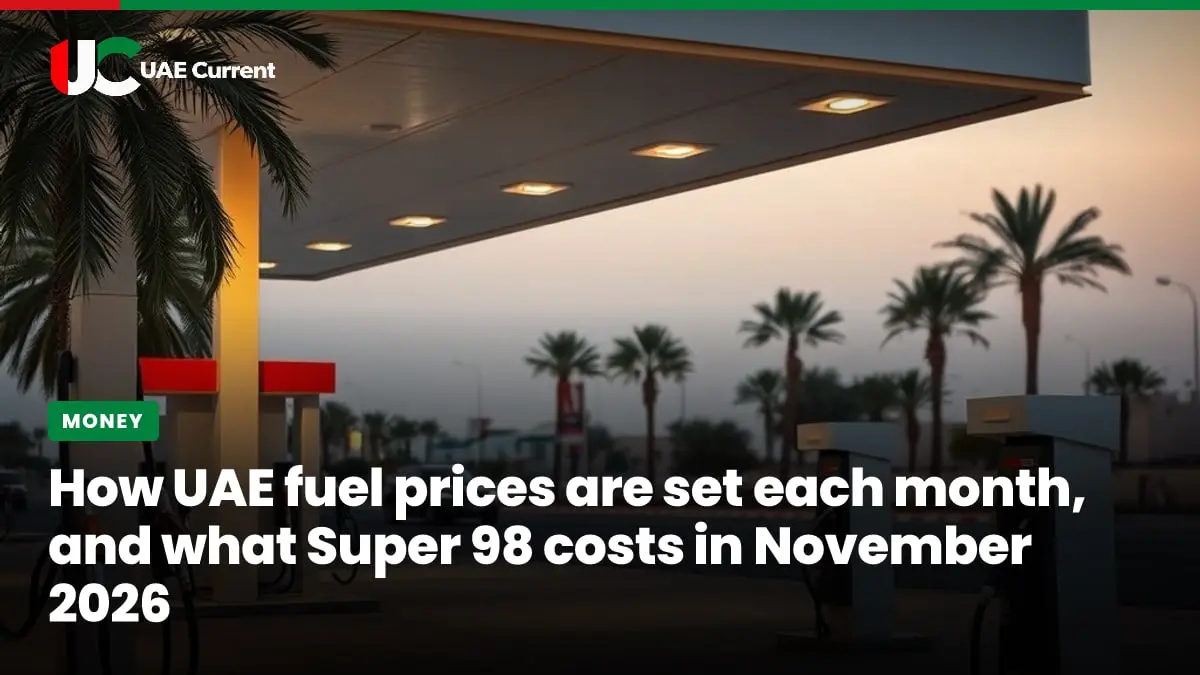
UAE fuel prices are set once a month by the Gasoline and Diesel Prices Follow-up Committee, often called the UAE Fuel Price Committee, which is chaired by the Ministry of Energy and Infrastructure. For November 2026, Super 98 petrol costs AED 4.16 a litre, Special 95 costs AED 4.04, E-Plus 91 costs AED 3.97 and diesel costs AED 4.75. These prices apply from 1 to 30 November 2026.
The UAE has linked petrol and diesel prices to world prices since August 2015, when it ended the old fixed, subsidised prices. Each month's prices are announced near the end of the month before. The December 2026 prices have not been announced yet.
UAE fuel prices for November 2026 are AED 3.97 to AED 4.75 a litre
The committee's November 2026 prices run from AED 3.97 a litre for E-Plus 91 to AED 4.75 a litre for diesel. All three petrol grades are cheaper than in October 2026, and diesel is also slightly lower. The prices stay fixed until 30 November.
| Fuel grade | Price per litre, 1 to 30 November 2026 |
|---|---|
| Super 98 petrol | AED 4.16 |
| Special 95 petrol | AED 4.04 |
| E-Plus 91 petrol | AED 3.97 |
| Diesel | AED 4.75 |
The November prices were published by the committee through the Emirates News Agency (WAM) on 31 October 2026. WAM is the official state news agency, and its monthly report is the place to check the approved figures.
The number in each grade's name is its octane rating. A higher octane petrol resists early burning in the engine, which some engines need. Your car's handbook, or the label inside the fuel cap, says which grade it is designed for.
Fuel prices follow world prices under a policy that began in August 2015
Since August 2015, the UAE has followed a fuel price deregulation policy for petrol and diesel. This means the pump price is no longer fixed by the government at a subsidised level. Instead, it is linked to average global prices for petroleum products, so it can rise or fall each month.
The official UAE government portal explains the reason. Subsidies on fuel encourage people to use more of it and to save less. Linking prices to world markets is meant to encourage public transport, more fuel-efficient cars, and a move towards electric, hybrid and lower-emission vehicles.
"Deregulation" here does not mean prices are left without oversight. The committee still reviews and approves the prices every month. What changed in 2015 is that those prices now follow the market instead of staying the same for years.
A committee led by the Ministry of Energy and Infrastructure reviews prices monthly
The Gasoline and Diesel Prices Follow-up Committee reviews petrol and diesel prices once a month. It is chaired by the Ministry of Energy and Infrastructure (MoEI). Other relevant government bodies and the fuel companies also take part in the committee's work.
According to the UAE government portal's page on energy and fuel prices, the pricing method looks at two things:
- the average global price of petroleum products, and
- the costs of operating and distributing fuel in the UAE.
Because the formula uses an average of world prices, the pump price does not jump with every daily move in oil markets. A sharp rise or fall in one week may only show up partly, or a month later. This is why the price can sometimes move in a different direction from the headlines about crude oil.
The main fuel retailers in the UAE are ADNOC, ENOC and Emarat. The fuel companies take part in the committee alongside the government. The portal lists each company's station finder, and the MoEI keeps a list of petrol stations too.
New prices are announced near the end of each month
The committee announces the next month's prices near the end of the current month, and the new prices start on the 1st. The November 2026 prices, for example, were announced on 31 October 2026. The December 2026 prices will be announced near the end of November.
The monthly cycle works like this:
- The committee reviews average global petroleum product prices and local operating and distribution costs.
- It approves one price per litre for each grade: Super 98, Special 95, E-Plus 91 and diesel.
- The approved prices are published through WAM near the end of the month.
- The fuel companies apply the new prices at their stations from the first day of the next month.
- The prices stay the same until the end of that month, when the cycle repeats.
Any price for December 2026 that you see before the official announcement is a guess. Wait for the committee's figures, published through WAM, before you plan around them.
What a full tank costs at November 2026 prices
To work out the cost of filling up, multiply your tank size in litres by the price per litre for your grade. A 50 litre tank of Special 95 costs AED 202 in November 2026, and a 70 litre tank of Super 98 costs AED 291.20.
| Tank size | Super 98 (AED 4.16) | Special 95 (AED 4.04) | E-Plus 91 (AED 3.97) |
|---|---|---|---|
| 40 litres | AED 166.40 | AED 161.60 | AED 158.80 |
| 50 litres | AED 208.00 | AED 202.00 | AED 198.50 |
| 60 litres | AED 249.60 | AED 242.40 | AED 238.20 |
| 70 litres | AED 291.20 | AED 282.80 | AED 277.90 |
These figures are simple multiplication from the committee's prices, for a tank filled from empty. In real life most drivers fill up before the tank is fully empty, so the amount you pay will usually be lower. Your car's handbook gives the exact tank size.
For a diesel vehicle, the same method applies. A 60 litre diesel fill at AED 4.75 a litre costs AED 285.
How drivers can plan around monthly price changes
Because prices change on the 1st of each month, the timing of a fill-up can make a small difference. When the new month's prices are lower, waiting a day or two saves money. When they are higher, filling up before the 1st does.
- Check the committee's prices on WAM at the end of each month before you decide when to fill up.
- Use the grade your car's maker recommends. Using a higher grade than needed costs more without a clear benefit for most cars.
- For family or business budgets, plan with the current month's price and review it on the 1st.
Questions about fuel prices can go to the Ministry of Energy and Infrastructure through its official channels. This is general information about how prices are set, not financial advice; see our disclaimer.
Frequently asked questions
Who sets fuel prices in the UAE?
The Gasoline and Diesel Prices Follow-up Committee sets them. It is chaired by the Ministry of Energy and Infrastructure, and other government bodies and the fuel companies take part.
How often do UAE petrol prices change?
Petrol and diesel prices are reviewed once a month. New prices start on the 1st of each month and stay the same until the month ends.
When will December 2026 fuel prices be announced?
The December 2026 prices will be announced near the end of November 2026, through WAM. Until then, any December figure is not official.
What is the price of Super 98 in the UAE in November 2026?
Super 98 costs AED 4.16 a litre from 1 to 30 November 2026. Special 95 costs AED 4.04, E-Plus 91 costs AED 3.97 and diesel costs AED 4.75.
Why did the UAE deregulate fuel prices?
The UAE deregulated petrol and diesel prices in August 2015 to link them to world prices. The government says subsidies encourage higher use, and market pricing supports public transport and more efficient cars.
Are fuel prices the same at ADNOC, ENOC and Emarat?
The committee approves one price per litre for each grade for the UAE each month, and the fuel companies, including ADNOC, ENOC and Emarat, take part in its work. The monthly announcement gives one figure per grade, not a price per company.
How we verified this
What we checked and where we read it.
- Energy and fuel prices, The Official Portal of the UAE Government, checked 16 November 2026
- UAE fuel and diesel prices for November 2026, Emirates News Agency (WAM), checked 16 November 2026
Spotted an error? Tell us and read our corrections policy.
About the author

Business, Economy and Markets Desk
Omar Al Haddad reports on the UAE economy, banking, taxation, energy and financial markets, turning complex figures into useful information for readers and business owners.
Omar Al Haddad is a desk byline. Desk reporting is researched and drafted with AI assistance and reviewed by the editor before publication. How this works
All articles by Omar Al Haddad →