
Dubai Rent Increase Rules: Landlords Can Raise Rent by 0% to 20% at Renewal
Dubai rent can rise only at renewal, by 0% to 20% depending on how far your rent is below the DLD index average, and only with 90 days' notice.
 By Rami Khoury
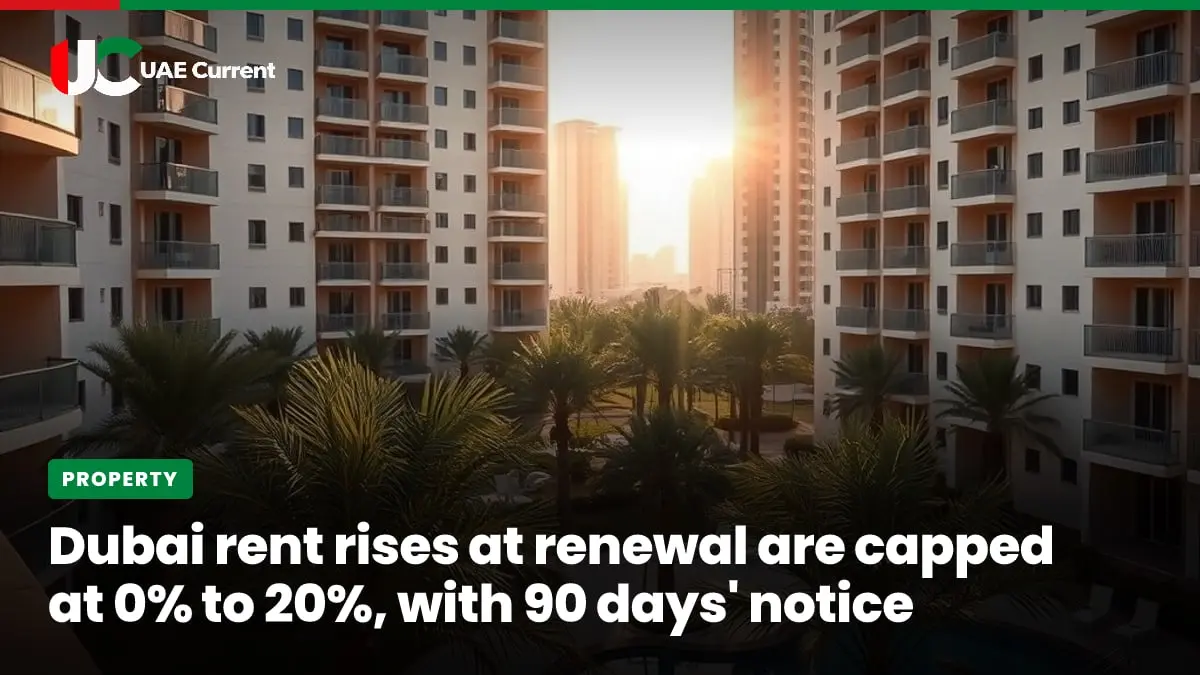
A Dubai landlord can raise the rent only when the lease is renewed, and only by 0% to 20%, depending on how far your current rent sits below the average rent for similar homes in the official Dubai Land Department (DLD) rental index. The landlord must also tell you about any change at least 90 days before the contract ends, unless your contract says otherwise. These Dubai rent increase rules come from Decree No. 43 of 2013 and Law No. 26 of 2007, as amended by Law No. 33 of 2008.
The quickest way to check your own case is the free Rental Index service on the DLD website or the Dubai REST app. If your rent is already close to the area average, the result is 0%, and the landlord has no right to an increase at that renewal.
Rent increases in Dubai follow five bands set by Decree No. 43 of 2013
The maximum increase depends on the gap between your current rent and the average market rent for a similar unit. The smaller the gap, the smaller the increase. No band allows more than 20%, and a rent within 10% of the average cannot go up at all.
Decree No. 43 of 2013 was issued by the Ruler of Dubai on 18 December 2013 and came into force on the day it was issued. It sets the "maximum increase" a landlord can apply when a lease is renewed. The average market rent comes from the Rent Index of the Emirate of Dubai, which is approved by the Real Estate Regulatory Agency (RERA), part of the DLD.
| How much your rent is below the area average | Maximum increase allowed at renewal |
|---|---|
| Up to 10% below (or at or above the average) | 0%, no increase |
| 11% to 20% below | 5% of your current rent |
| 21% to 30% below | 10% of your current rent |
| 31% to 40% below | 15% of your current rent |
| More than 40% below | 20% of your current rent |
The decree applies to landlords across Dubai, including special development areas and free zones. The DLD's current residential index, however, does not cover the Dubai International Financial Centre (DIFC), so tenants in DIFC buildings should check the rules that apply there.
The rent increase is worked out as a percentage of your current rent
The calculation has two steps. First, find how far your rent is below the index average, as a percentage. Then apply the band from the table to your current rent, not to the average. The DLD's own tenancy guide gives this worked example.
- Average rent in the official index: AED 80,000 a year.
- Current rent in your contract: AED 60,000 a year.
- Gap: (80,000 minus 60,000) divided by 80,000, multiplied by 100, which is 25%.
- A 25% gap falls in the 21% to 30% band, which allows a 10% increase.
- Increase: 10% of AED 60,000 is AED 6,000, so the new rent can be up to AED 66,000.
Note that the new rent of AED 66,000 is still below the average of AED 80,000. The bands are designed to move rents towards the market level in steps, not in one jump. A landlord who asks for AED 80,000 in this case is asking for more than the decree allows.
Landlords must give at least 90 days' notice before the lease ends
Either side who wants to change the rent or any other term of the lease must tell the other side no less than 90 days before the contract expires. This comes from Article 14 of Law No. 26 of 2007, as amended in 2008. The contract can set a different period if both sides agreed to it.
The DLD's frequently asked questions put it the same way: an owner can increase the rent based on the rental index, with three months' prior notice to the tenant. The law defines a notice as a written notification sent through a notary public, by registered post, by hand, or by another technological means approved by law. Keep a copy of any notice you receive, with the date it reached you.
The same 90 day rule works in your favour too. If you want to ask for a lower rent at renewal, or you do not plan to renew, give your landlord written notice at least 90 days before the end date.
Eviction at the end of a lease needs 12 months' notice
A rent increase is different from an eviction. Under Article 25 of the amended law, a landlord who wants a tenant to leave when the lease ends can do so only for set reasons, such as selling the property, demolition, major maintenance, or use by the owner or a first-degree relative. In those cases the landlord must give 12 months' notice of the reason, through a notary public or registered post.
How to check your rent increase on the DLD rental index
The DLD's Rental Index service is free and takes a few minutes. It asks for your contract end date, the property details and your current annual rent, then shows the average rent for similar units and the increase allowed. You can use it on the DLD website or in the Dubai REST app.
- Open the Rental Index service on the Dubai Land Department website, or the Rental Index service in the Dubai REST app.
- Choose the property category. For a flat or villa, choose Residential.
- Enter your contract end date. Use the end date of your current lease, since the increase applies at renewal.
- Find your property by its DEWA premise number, your Ejari contract number, or by area and building name. The Ejari number is on your Ejari certificate.
- Enter the number of bedrooms and your current annual rent in AED.
- Complete the captcha and press Calculate. Save or screenshot the result, with the date.
Compare the result with what your landlord has asked for. If the landlord's figure is within the result, the increase is allowed. If it is higher, you have grounds to negotiate, and the screenshot is useful evidence.
The Smart Rental Index now rates each building
Since 2 January 2025, the DLD has used the Smart Rental Index 2025 for residential property. It rates buildings on their quality, services and location, and uses those ratings with registered rental contracts to set the average rent. The 0% to 20% bands from Decree No. 43 of 2013 still decide the increase.
According to the DLD, buildings are classified on criteria including construction quality, architectural design, energy efficiency, the services provided and location. The system uses artificial intelligence and data from registered rental contracts in Dubai, and the index is updated once a year. An owner or landlord can ask the DLD to update a building's classification.
In practice, this means two flats with the same number of bedrooms in the same area can have different averages if their buildings are rated differently. That is why the calculator asks for the building, not only the area. The DLD says the index is indicative and not mandatory for a new lease. It matters most at renewal, when the tenant and the landlord disagree on the increase. Commercial and industrial versions of the smart index are still being developed.
Tenants who disagree can file a case at the Rental Disputes Center
Talk to your landlord first, with your calculator result in hand. If you cannot agree, either side can file a case at the Rental Disputes Center (RDC), which handles disputes between landlords and tenants in Dubai. Cases start with an amicable settlement stage before any judgment.
Under Article 13 of the amended law, when the two sides cannot agree on the rent at renewal, the tribunal may set a fair rent. Under Article 9, it looks at the RERA criteria for increases, the condition of the property and the average rent of similar properties in the same area.
According to the RDC's amicable settlement service page, you can register online on the RDC website or at a Real Estate Services Trustees Centre. You attend a conciliation session through the RDC's tele-litigation system. If you settle, you sign the agreement online, and a supervising judge approves it so it can be enforced.
Documents and fees for a rent dispute
The RDC asks for your latest Ejari lease, your Emirates ID (or a trade licence and the manager's ID for a company), a bank letter or statement showing your IBAN, and any supporting papers such as notices, cheques and letters. Every document must be in Arabic or legally translated into Arabic, and uploaded to the RDC platform.
| RDC fee item | Amount |
|---|---|
| Lease renewal, eviction, rent claim or termination case | 3.5% of the annual rent, minimum AED 500, maximum AED 20,000 |
| Process service | AED 100 |
| Power of attorney registration, if used | AED 25 |
| Knowledge fee and innovation fee | AED 10 each |
| Extra fee when filed at a Trustees Centre | AED 130, plus VAT on that fee |
If the case is settled at the conciliation stage, the RDC refunds half of the court fee paid for basic claims. Registration takes one business day. On a rent of AED 60,000, the 3.5% case fee works out at AED 2,100.
This is general information about the rules, not legal advice. For a decision on your own lease, contact the DLD or the RDC, and see our disclaimer.
Frequently asked questions
How much can a landlord increase rent in Dubai?
A landlord can increase rent by 0% to 20% at renewal, depending on how far your rent is below the area average in the DLD rental index. If your rent is within 10% of the average, no increase is allowed.
How many days' notice must a Dubai landlord give for a rent increase?
The landlord must give at least 90 days' notice before the lease expires, unless your contract sets a different period. The notice should be in writing, for example by registered post, notary public or another approved method.
Can my landlord raise the rent in the middle of the contract?
The increase bands in Decree No. 43 of 2013 apply when the lease is renewed, not during its term. The law deals with rent reviews for the purpose of renewal, with at least 90 days' notice before the contract ends.
Is the DLD rental increase calculator free to use?
Yes, the Rental Index service on the DLD website shows no fee. You need your contract end date, the property details and your current annual rent.
What if the calculator says 0% but my landlord still wants more?
Under the decree, a 0% result means no increase is allowed at that renewal. Show the landlord the result, and if you still cannot agree, you can file a case at the Rental Disputes Center.
Does the rental index apply in the DIFC?
The DLD says its Smart Residential Rent Index covers all residential areas in Dubai except the Dubai International Financial Centre. DIFC tenants should check the rules that apply in the DIFC.
How much does it cost to file a rent dispute in Dubai?
The RDC fee for a lease renewal case is 3.5% of the annual rent, with a minimum of AED 500 and a maximum of AED 20,000, plus small service fees. Half of the court fee for basic claims is refunded if you settle at conciliation.
How we verified this
What we checked and where we read it.
- Decree No. 43 of 2013 Determining the Increase in Real Estate Rentals in the Emirate of Dubai, Dubai Land Department, checked 16 November 2026
- Dubai Land Department Tenancy Guide, with Law No. 26 of 2007 as amended by Law No. 33 of 2008, checked 16 November 2026
- Rental Index service, Dubai Land Department, checked 16 November 2026
- Smart Residential Rent Index questions and answers, Dubai Land Department, checked 16 November 2026
- Register Dispute Lawsuit, Amicable Settlement, Rental Disputes Center, checked 16 November 2026
Spotted an error? Tell us and read our corrections policy.
About the author

Property, Construction and Infrastructure Desk
Rami Khoury reports on UAE property, construction, transport and infrastructure, examining projects through planning data, regulation and market evidence.
Rami Khoury is a desk byline. Desk reporting is researched and drafted with AI assistance and reviewed by the editor before publication. How this works
All articles by Rami Khoury →