
Dubai School Fee Increase Rules: No Rise in 2026-27 and How KHDA Sets the Cap
Dubai private schools cannot raise fees in 2026-27. In a normal year, KHDA caps any rise using the Education Cost Index, last set at 2.35%, and each school's inspection rating.

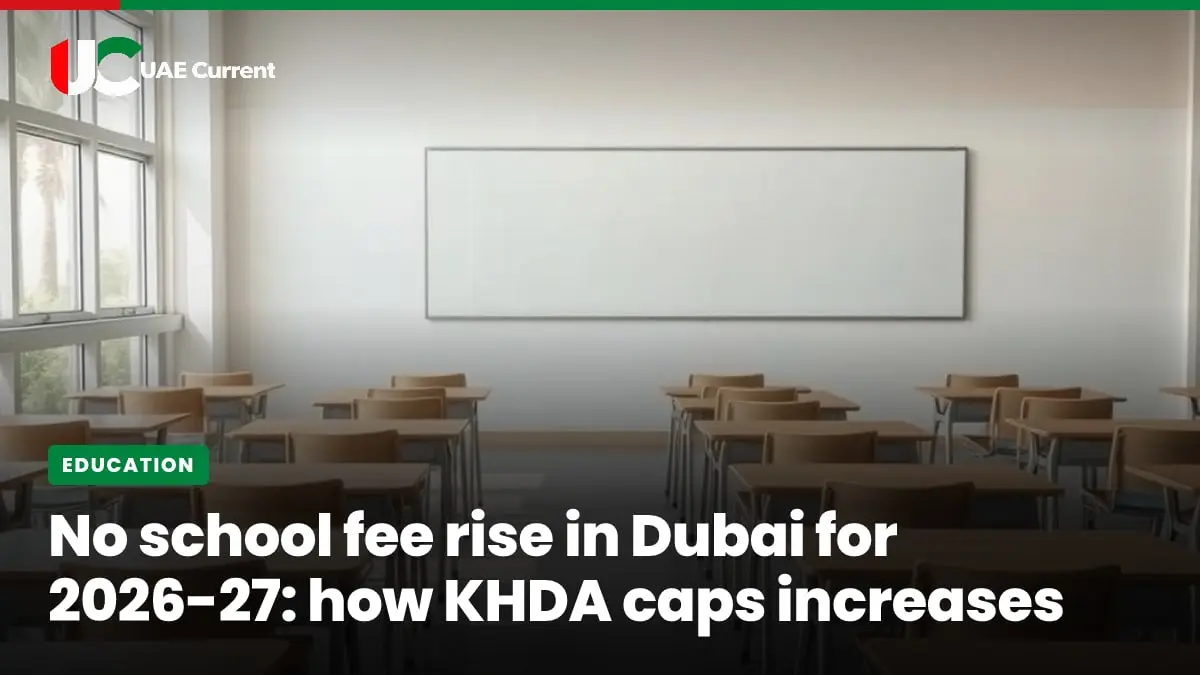
Dubai private schools cannot raise their fees at all in the 2026-27 academic year. The Knowledge and Human Development Authority (KHDA), which regulates private education in Dubai, confirmed the freeze on 22 May 2026, under the directives of His Highness Sheikh Hamdan bin Mohammed bin Rashid Al Maktoum, Crown Prince of Dubai. In a normal year, Dubai school fee increase rules link any rise to two things: the Education Cost Index (ECI) and the school's inspection rating.
The last approved index was 2.35%, for the 2025-26 academic year. No school can change its tuition fees without KHDA approval, and a school that does so faces a fine of AED 150,000.
There is no school fee increase in Dubai for 2026-27
KHDA has confirmed that private schools in Dubai will not increase school fees for the 2026-27 academic year. The decision applies to private schools across the emirate and is part of the second economic incentives package approved for Dubai, valued at AED 1.5 billion.
According to the Dubai Media Office announcement of 22 May 2026, the freeze followed the approval of that package, which brought the total value of recent economic incentives in Dubai to AED 2.5 billion. The same package gives private schools deferrals or instalments on their licence renewal fees, and deferred fines.
In practice, this means the fees on your school's KHDA-approved fact sheet for 2025-26 should not go up in 2026-27. If your school's invoice for this year shows a higher tuition fee for the same grade, ask the school to explain it in writing.
How the Education Cost Index sets the ceiling
The Education Cost Index is a yearly measure of how much it costs to run a school in Dubai. KHDA approves one index each year, and it becomes the basic ceiling for fee increases. When the index is zero or negative, schools get no increase.
For 2025-26, KHDA approved an ECI of 2.35% for for-profit private schools on 2 May 2025. KHDA said the figure was based on its annual review of audited financial statements from Dubai private schools, in collaboration with the Digital Dubai Authority. The index takes in the main running costs of a school, including staff wages, support services and rent.
In that year, eligible for-profit schools could apply for an increase up to, but not above, the approved 2.35%. Schools that had been running in Dubai for less than three years could not apply at all. On a tuition fee of AED 40,000 a year, a 2.35% rise is AED 940, so the most the school could ask for was AED 40,940.
Recent fee decisions in Dubai
| Academic year | Education Cost Index | Result for parents |
|---|---|---|
| 2020-21 | Minus 2.35% | No tuition fee increase |
| 2021-22 | Minus 2.58% | No tuition fee increase |
| 2022-23 | Minus 1.01% | No tuition fee increase |
| 2025-26 | 2.35% | Eligible for-profit schools could apply for up to 2.35% |
| 2026-27 | Not applied | No fee increase, confirmed on 22 May 2026 |
KHDA has announced its fee decisions between February and May in recent years, before schools open re-registration for the following year.
The School Fees Framework links increases to inspection ratings
KHDA's School Fees Framework decides how much each for-profit school may add. A school that keeps its inspection rating can add the ECI. A school that improves its rating can add more. A school whose rating drops gets no increase.
The KHDA School Fees Framework uses the latest rating given by the Dubai School Inspection Bureau (DSIB). It applies to private schools that have completed three years of operation, and not to schools that charge no tuition fees.
| Change in the school's inspection rating | Maximum fee increase |
|---|---|
| Kept the same rating as the previous year | The ECI |
| Improved from Very Weak to Weak, Weak to Acceptable, or Acceptable to Good | The ECI multiplied by 2 |
| Improved from Good to Very Good | The ECI multiplied by 1.75 |
| Improved from Very Good to Outstanding | The ECI multiplied by 1.5 |
| Dropped to a lower rating | No increase |
| Inspected for the first time | The ECI only |
As a worked example, with an ECI of 2.35%, a school that moved from Good to Very Good could ask for up to about 4.11% (2.35 multiplied by 1.75). The framework adds three conditions. Schools rated Acceptable or lower must submit a KHDA-approved action plan on how they will invest in quality. A school that lowers its fees cannot later go back to the old, higher fees. And an increase meant for one year cannot be carried forward to a later year.
Not-for-profit schools follow a different route. Their proposed increase is approved if they submit board approval and evidence that parents were consulted and that the parents' representative endorsed it.
Exceptional increases under the Fair Rate of Return
A school can also ask for a larger, exceptional increase if its profit is below a set level. Under Executive Council decision 16/2015, the threshold is 10% for an Outstanding school, 9.5% for Very Good, 9% for Good, 8% for Acceptable and 7% for Weak or Very Weak. The school must have operated for at least six academic years, be at least 80% full, and spend at least 25% of its total costs on teachers' basic salaries. Only one such application is allowed in 12 months.
Inspections return in 2026-27, so ratings will matter again
KHDA paused school inspections for 2025-26, except for schools in their third year of operation. In that same year, KHDA capped every eligible school's increase at the ECI, with no multipliers. Inspections resume in 2026-27, and new ratings will be published after full visits.
KHDA announced on 3 June 2026 that every eligible private school will get one of two visits this year. A full inspection applies the UAE School Inspection Framework and ends with a published report and an overall rating. A shorter monitoring visit gives a report on strengths and areas to improve, but no new rating. Schools get no more than 24 hours' notice of either visit.
KHDA has not said how the new ratings will feed into the fee decision for 2027-28. Under the framework as published, a school's latest rating is the one used. Parents can see each school's rating and inspection reports on the KHDA website and app.
What Dubai schools may and may not charge
A Dubai private school can charge only the fees KHDA has approved, as listed on its School Fees Fact Sheet. Deposits are capped, payment must be spread across the year, and no extra payment can be demanded to hold a place.
These rules come from Executive Council Resolution No. 2 of 2017, which regulates private schools in Dubai, including those in free zones such as the Dubai International Financial Centre (DIFC), and from KHDA's Registration and Refund Policy for Dubai private schools. Under Article 13 of the resolution, a school must not change or discount tuition fees without KHDA approval, and must publish its tuition fees on its own website.
- Application fee: up to AED 500. It is refunded if your child is not offered a place, and it is not deducted from tuition.
- Registration deposit for a new pupil: no more than 10% of the annual tuition fee, and only after a formal offer you have accepted. It is deducted from the first term's fees.
- Re-registration deposit: no more than 5% of annual tuition or AED 500, whichever is higher, deducted from the next year's fees.
- Refund of deposits: refundable if you give formal notice at least 60 calendar days before the school year starts.
- Instalments: three term payments of no more than 40%, 30% and 30% of annual tuition, or 10 equal monthly payments if the school offers them.
- No other payment may be demanded to guarantee enrolment or re-enrolment.
The fines in Schedule 2 of the resolution are heavy. Changing tuition fees without approval costs a school AED 150,000, discounting without approval AED 50,000, and breaking the re-enrolment fee rules AED 20,000. A repeat of the same violation within one year doubles the fine, up to AED 500,000. The rules work much like the Dubai rent increase rules, where an official index caps what can be added each year.
How to check your fees and complain to KHDA
Start with your school's School Fees Fact Sheet, which lists every mandatory and optional fee for the year. If a charge is not on it, or looks higher than approved, raise it with the school first. If that fails, you can take the dispute to KHDA.
- Find the School Fees Fact Sheet for your child's school in the KHDA directory, on the school's website, or with your parent and school contract.
- Scan the QR code on the fact sheet to confirm it is genuine. Each fact sheet is valid for one academic year.
- Compare the tuition, mandatory fees and deposits on your invoice with the fact sheet and the limits above.
- Put your question or complaint to the school in writing, and use its internal complaints process. Under the resolution, every school must receive complaints from students and parents and form a committee to consider them.
- Keep copies of the invoice, the fact sheet, emails and the school's reply. KHDA expects the school's internal steps to be completed and documented first.
- If the dispute is not resolved, refer it to KHDA through its official channels. KHDA has the power to receive and investigate complaints against private schools, and may ask both sides for documents.
KHDA regulates tuition fees, including application, registration and re-enrolment fees, and the mandatory fees on the fact sheet. It does not regulate optional extras outside the curriculum, such as school trips and after-school activities, which are governed by your agreement with the school or the provider. This is general information, not legal advice; see our disclaimer.
Frequently asked questions
Are Dubai school fees going up in 2026-27?
No. KHDA confirmed on 22 May 2026 that there will be no increase in fees for Dubai private schools in the 2026-27 academic year.
What is the latest Education Cost Index in Dubai?
The latest approved index is 2.35%, set by KHDA on 2 May 2025 for the 2025-26 academic year. No index was applied for 2026-27 because fees are frozen.
Can a school raise fees if its inspection rating drops?
No. Under the KHDA School Fees Framework, a for-profit school whose rating falls to a lower level is not allowed any fee increase.
Can a new school in Dubai increase its fees?
Not in its first three years. The framework applies only to schools that have completed three years of operation, and KHDA said schools running for less than three years were not eligible for the 2025-26 adjustment.
How much deposit can a Dubai school ask for?
A registration deposit for a new pupil can be up to 10% of the annual tuition fee. A re-registration deposit can be up to 5% of annual tuition or AED 500, whichever is higher.
Can a school make me pay the full year's fees in advance?
No. Schools can collect annual tuition only in three term instalments of no more than 40%, 30% and 30%, or as 10 equal monthly payments.
Does KHDA regulate school bus and trip fees?
KHDA regulates tuition and the mandatory fees on the school's fact sheet. Optional services such as trips and extracurricular activities are governed by the terms agreed between parents and the school or the provider.
How we verified this
What we checked and where we read it.
- KHDA confirms no fee increase for Dubai's private schools in 2026-2027 academic year, Dubai Media Office, 22 May 2026, checked 16 November 2026
- Education Cost Index set at 2.35% for Dubai's for-profit private schools in 2025-26, KHDA, 2 May 2025, checked 16 November 2026
- School Fees Framework, KHDA, checked 16 November 2026
- KHDA to resume quality assurance visits for Dubai private schools from 2026-27, KHDA, 3 June 2026, checked 16 November 2026
- Executive Council Resolution No. 2 of 2017 Regulating Private Schools in the Emirate of Dubai, Dubai Legislation Portal, checked 16 November 2026
- Schools Fees Fact Sheet FAQs, KHDA, checked 16 November 2026
- Registration and Refund Policy for all Dubai Private Schools, KHDA, checked 16 November 2026
Spotted an error? Tell us and read our corrections policy.
About the author

Policy and Public Affairs Desk
Mariam Al Nuaimi covers UAE government decisions, public services and regulatory changes, explaining what official announcements mean for residents, families and businesses.
Mariam Al Nuaimi is a desk byline. Desk reporting is researched and drafted with AI assistance and reviewed by the editor before publication. How this works
All articles by Mariam Al Nuaimi →